Before you pay
Is it safe to pay for IPTV?
Yes, with one condition: the payment request has to be an ordinary one. What a normal request looks like, the nine versions that should end the conversation, how to check a seller in ten minutes, and where you stand if you have already sent money to somebody who has gone quiet.
Paying is safe when three things hold: the total is agreed in writing before any link appears, the card or wallet details go into a payment page rather than into a chat message, and the method you use leaves somebody you can appeal to afterwards. Almost nothing that goes wrong in this market is sophisticated. It is money sent down a route with no reverse gear, to a seller who had never put anything in writing, in a hurry.
What actually goes wrong, and what does not
The fear people arrive with is dramatic — a cloned card, a drained account, a stranger with their details. That is not what the complaints in this market look like. Paying on a genuine payment page is one of the better-protected things you can do with money online, and card fraud is not the risk that costs IPTV buyers money.
The real losses are duller and slower. Somebody pays, receives nothing, and finds the handle no longer replying. Or somebody pays, watches happily for five weeks, and then the subscription dies mid-evening and the seller has closed the channel and opened another one under a new name. In both cases the payment worked perfectly. The problem was never the card; it was who was on the other end and what route the money took to reach them.
So the safety question splits in two, and they are worth keeping separate. First: is this payment request a normal one, or is it shaped in a way that removes your options? Second: is this seller likely to still be trading in March? The nine signals below cover the first question and the checklist further down covers the second — and the choice of rail, which decides what you can do afterwards, is broken down method by method on IPTV payment methods.
Nine payment requests that should stop you
1. The money has to travel by a route that cannot be reversed
This is the strongest signal on the list, and it requires no suspicion about anyone. There is a category of money-movement service built to deliver funds to a named person quickly, with no dispute process attached. It is perfectly legitimate technology and families use it every week. It is also the route most often requested in online fraud, for exactly the property that makes it useful.
A seller who accepts several ordinary methods is a seller whose payment arrangements have survived contact with a payment company — a small but genuine piece of evidence. A seller who will take nothing except a rail with no reverse gear has chosen the arrangement in which you have no position at all. It does not matter how the insistence is dressed: processing fees, a temporary problem with the card system, a discount for paying that way.
Cryptocurrency belongs in the same final category and is treated differently here for one reason only: it is offered as one option among several rather than demanded as the only one. Choosing it knowingly is a decision. Being pushed onto it is a warning.
2. The card number is supposed to go into the chat
Card details belong on a payment page and nowhere else. If a seller asks you to type the long number into a message, read it out, photograph the card, or fill in a form they emailed over, the request itself is the finding. No payment company works that way, because no payment company would allow a merchant to collect card numbers by hand.
The tell is often framed as helpfulness — the payment page is down, it is easier this way, they will enter it for you. A working business does not have that problem, and a business that genuinely did would reschedule rather than improvise. There is no version of this that ends with you better off.
The same applies to a security code read aloud, a one-time passcode from your banking app, or a screenshot of a payment screen. Those exist to stop somebody else moving your money. Handing them over is handing over the thing they protect.
3. The amount on the page is not the amount you agreed
Read the payment page before you read the message describing it. The page is the transaction; the message is only a description, and the two do not always match. A figure higher than the one quoted, with an explanation arriving afterwards about fees or currency or the plan you apparently chose, is not a rounding error. It is the price being changed at the one moment you are least likely to argue.
The correct response is to close the page and ask for a corrected link. Watch what happens next. A business fixes it in a minute and apologises. A funnel explains why the higher number is actually correct, then applies a little pressure about the slot being held.
The same rule covers anything added after agreement: an activation fee, a setup charge, a first-time processing cost. A total agreed in writing is a total. Anything appearing afterwards was always going to appear.
4. Payment is wanted before a single question is answered
A payment link should arrive after the total, the term and the renewal figure, not instead of them. When a link turns up in the first two messages, before anybody has established what you are buying, the order of events is telling you what the seller is optimising for.
Test it deliberately, because it costs nothing. Ask what the renewal figure will be and whether a card is stored, and see whether the answer arrives as two short facts or as a paragraph about quality. Sellers who run a real operation already know their own numbers and say them immediately. Nobody has to check.
This is also the cheapest possible test of support. How a seller answers an awkward question while they still want your money is the most optimistic version of how they will answer one after they have it.
5. The price exists only inside the conversation
Quote privately and the figure can be tuned per customer, weighed against nobody, and disowned twelve months later when the renewal number bears no resemblance to what you remember agreeing. Nothing exists to point at. That is not a quirk of the business model. It is the model.
The usual defence is that prices move with region and with screen count. Both true, and neither stops anybody building a table. Currencies go in a column, screen counts go in a row, and the whole thing fits on one page. A missing price list is a choice somebody made.
Ours is a decision in the other direction: $69, $97 and $137 sit on the pricing page before you speak to anybody, which is precisely why we can be held to them.
6. A card is kept on file so the subscription can renew itself
More money goes this way than through any outright scam on the list, and no dishonesty is required for it to work. Once your card is parked on a seller system, the renewal is no longer something you agree to. It is something you find out about later, at whatever rate happened to apply that morning.
Add an introductory price on top and the familiar shape appears: year one cheap, the standard rate buried in the terms in smaller type, and a stored card quietly making up the difference the moment month thirteen arrives. Concealed is not quite the word. It is simply never in view at the moment of purchase.
Two questions defuse the whole thing, and both can be asked before a penny moves. Does my card stay on file once this payment goes through? And if I do nothing when the term is up, what then? You are looking for no, and for it lapses.
7. There is a clock running on the payment
Countdown timers, three slots left at this price, a discount expiring in eleven minutes that is still expiring tomorrow. Urgency has exactly one job, which is to keep you from doing the two things this page keeps recommending: reading the payment page properly, and getting those two questions answered first.
Nothing is wrong with a genuine promotion — most sellers run them, this one included. What matters is whether the pressure survives being questioned. With the timer still running, ask for the renewal figure in writing. A business types it out. A funnel repeats the offer, slightly louder.
Urgency attached to the payment method specifically is worse: pay this way in the next ten minutes and the price holds. That is two warnings wearing one coat.
8. Documents are requested that a subscription has no use for
An order needs a name, a messaging number and the device you intend to watch on. It does not need a scan of your passport, a selfie holding your card, a utility bill, a date of birth or a home address. Nothing is being shipped and nothing is age-restricted, so there is nothing to verify.
Requests like these are usually framed as anti-fraud checks, which is a neat inversion — the documents that verify you are exactly the documents that are valuable to somebody else. A seller genuinely worried about fraudulent payments uses a payment processor, which handles that problem professionally and never asks you for a photograph.
The same goes for remote access. Setup help is instructions you follow yourself, on the setup page or in a message. An offer to take control of your phone or television to sort it out is a different transaction entirely.
9. Nothing is written down afterwards
After payment you should have two things: a confirmation carrying an amount, a date and a reference, and a line in the chat naming what you bought and the date it expires. Both are trivial for an honest seller to produce and both are the entire evidence pack for any dispute you might later need.
A seller who cannot produce a receipt is not automatically dishonest, but they are running the sort of operation where nothing is recorded — and that is the operation you cannot hold to anything. The absence of an expiry date is the sharpest version: without it you have no way of knowing whether you bought twelve months or a trial that expires in a fortnight.
Ask for it before you pay, not after. What a receipt should contain, item by item, is set out on how to pay for IPTV.





 + more
 What an ordinary payment request looks like
Told only what to steer clear of, you are left with nothing to steer towards, so here is the other half. None of it is exotic or generous. These are the commitments that cost nothing to make if you mean to keep them and a great deal if you do not, which is precisely why they split the field so cleanly.
The total is settled before any link exists.
The figure, the term and the screen count written into the chat, in that order, before a payment page is ever opened.
The card details never enter the conversation.
A payment company collects them on its own page. What reaches the seller is a confirmation that an amount cleared, not a number.
Several ordinary methods are on the table.
Card, Apple Pay, Google Pay, PayPal and cryptocurrency, at the same price, with no steering towards whichever one cannot be reversed.
The amount on the page matches the amount quoted.
To the cent, with no handling charge appearing at the last moment and no rounding that happens to go upward.
Nothing is stored and nothing renews itself.
Do nothing and the subscription lapses, so renewing stays something you choose rather than something you spot on a statement.
A receipt arrives without being chased.
An amount, a date, a reference, and a plain description of what was bought and the date it expires.
The price is public before you ask for it.
Printed where anyone can compare it, which is also what lets you hold the seller to it twelve months later.
Awkward questions get short answers.
What happens at renewal, what happens when a feed drops. One line each. Warmth in place of an answer is the answer.
A seller showing most of that has very little room left to surprise you. That it stands out at all says more about the market, a good deal of which has worked out that the opposite pays better in the short run. Our own version of each commitment is public rather than promised in a chat — the numbers on the pricing page, the terms on the refund policy, and the rest in the FAQ.
Ten minutes of checks before you pay anybody
Paste the following into a message and fire it at any seller under consideration, this one included. Two minutes of typing, nothing spent, and it sorts the field faster than an evening of reading reviews. Watch the shape of what comes back as closely as the content: a bare number tells you something, a paragraph of reassurance does not.
- What is the total for twelve months? One figure, including anything added later.
- What will I pay if I renew? A number in writing, not a description of a number.
- Is my card stored afterwards? The answer you want is no, and it should be instant.
- What happens if I do nothing at the end? The answer you want is that it lapses.
- Which payment methods do you take? A handful of ordinary ones is healthy. One, pressed hard, is not.
- Where is the price list published? Answer comes back as this chat, and nobody can be held to anything.
- What exactly arrives after payment, and how? Credentials and a receipt, on this thread, is the right answer.
- What date does the subscription expire? A real date. This is how you know you bought a year.
- Does the payment page belong to a payment company? Check the address bar before the amount, not after.
- Does the amount match, to the cent? Screenshot the quote first, so there is something to compare against.
Ours, for the record. Twelve months costs $69, $97 or $137 according to how many screens you want, and nothing is bolted on later. Renewal is quoted at that same figure. No card is stored, for the simple reason that none ever reaches us. Do nothing and it lapses. Card, Apple Pay, Google Pay, PayPal and cryptocurrency all cost the same. The list lives on the pricing page. Login and receipt land in the thread you ordered in. The expiry date is spelled out. Put the same questions to us on WhatsApp or Telegram and the answers come back identical, which is the entire reason for printing them here.
Move quickly, because every route back has a deadline. Gather the evidence first and it takes ten minutes: screenshots of the conversation showing what was promised, the payment confirmation showing the amount and date, and the reference number. That is the whole case, and it is far easier to collect now than after a messaging account has been deleted.
Then act on the method rather than on the seller. A card, Apple Pay or Google Pay payment is disputed through your own card issuer, not through the merchant — describe it as goods or services not received, and expect a window of roughly a hundred and twenty days from the payment, though your issuer sets the exact rule. A PayPal payment has its own claims process with its own clock. A confirmed cryptocurrency transfer has neither, and any service offering to recover it for a fee is a second loss waiting to happen.
If a recurring charge was ever set up, cancel the authority with your card issuer rather than relying on the seller to stop it. An operation that has gone quiet is not going to process a cancellation request, and the charges continue perfectly happily without anybody at the other end.
Then approach the next purchase as a decision in its own right, not a rescue mission. Agree the total in writing, pay by something with a way back, and work through the order sequence on how to pay for IPTV before any money moves again.
Questions people ask about paying safely
Three exchanges in a chat window. That is the whole process.
Nobody visits, nothing is signed, and no long number of yours gets typed into a form on this website. You tell the desk what you need, settle it on a rail of your choosing, and the credentials come back down the same thread you started in.
Written up by the people who already paid
Accounts from buyers across the US, UK, Ireland, Australia and Canada, focused on the bit that worries everyone: which rail they used, how long the gap was, and who picked up when they needed something sorting.
An ordinary card, not a wire
The deciding factor was being handed a normal card checkout rather than pointed at some app that moves money one way only. One charge of sixty-nine dollars, and roughly four minutes later the credentials were sitting in WhatsApp.
They kept nothing of mine
Twice before I have been stung by a service that quietly helps itself again a year on. Here there is no card on file to help itself with. The year runs out, the login stops, and that is the end of it unless I say otherwise.
Went through PayPal deliberately
Any other way and I would have walked. Routing it through PayPal meant a route back existed if the whole thing evaporated. It did not, but I slept better for having the option.
Still choosing an app when it arrived
I was halfway through reading about which player to install when the message landed. Every single thing they had promised would be in it was in it, spelled out, nothing missing.
I led with the difficult questions
Refunds, what happens the night a channel disappears, who exactly I chase. All three came back plainly inside a few minutes with no attempt to sell at me. That conversation is why I ordered.
One line on a whole year of statements
A hundred and thirty-seven dollars did the entire household for twelve months. Tablet upstairs, television downstairs, my phone out in the garden — and exactly one entry to reconcile at the end of it.
A number, printed, before I asked
Everyone else wanted me in a chat begging for a quote before they would commit to a figure. This one was on the page before anybody knew my name, and it matched what I eventually handed over.
Crypto, and a receipt in writing
Moved USDT across and had written confirmation plus my login inside ten minutes. The following day somebody messaged unprompted to check the setup was still holding up.
Something broke; somebody fixed it
A stream fell over on a Saturday evening. One message, and it was working again before the restart. Having an actual person at the far end is most of what the money buys.
The second year was my call
Twelve months on I sent a single message and handed over the same figure again. Nothing had been taken in the meantime, and every favourite and setting was exactly where I had left it.
The opposite of the warning signs above
Every red flag on this page describes a seller who goes quiet. So it seems fair to show the reverse: threads that keep running after the money moved — the correction when a reminder went out by mistake, the help setting up a second television, the renewal a year on. Twelve are shown here, picked out of a great many more of the same; that last kind is the only proof that really counts.
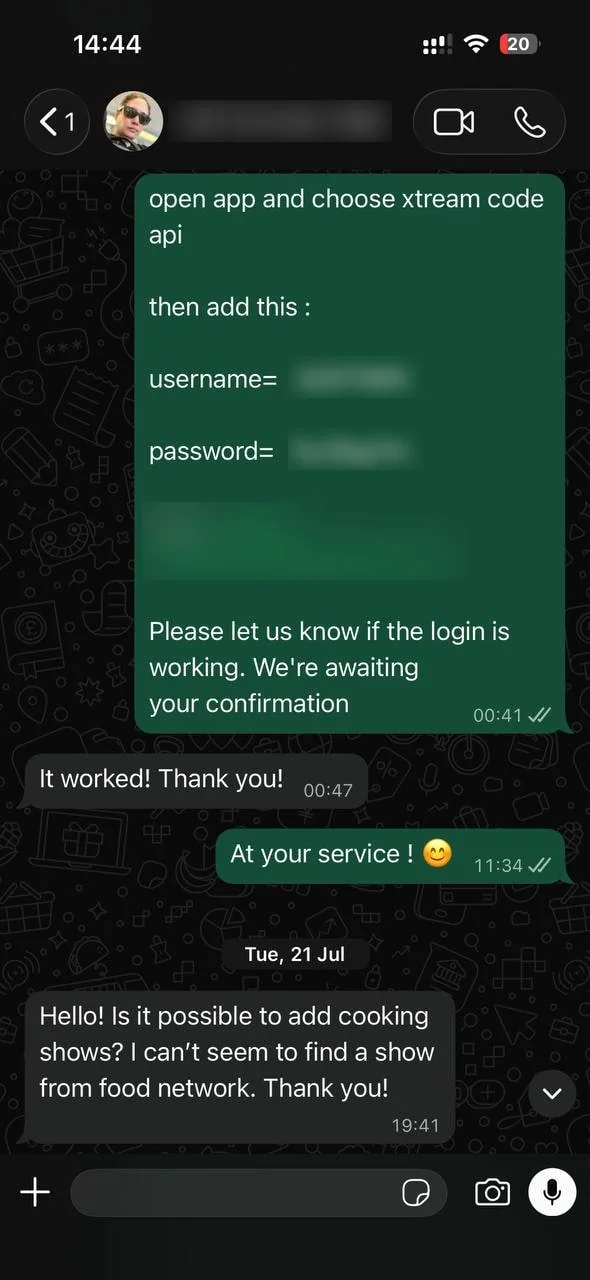
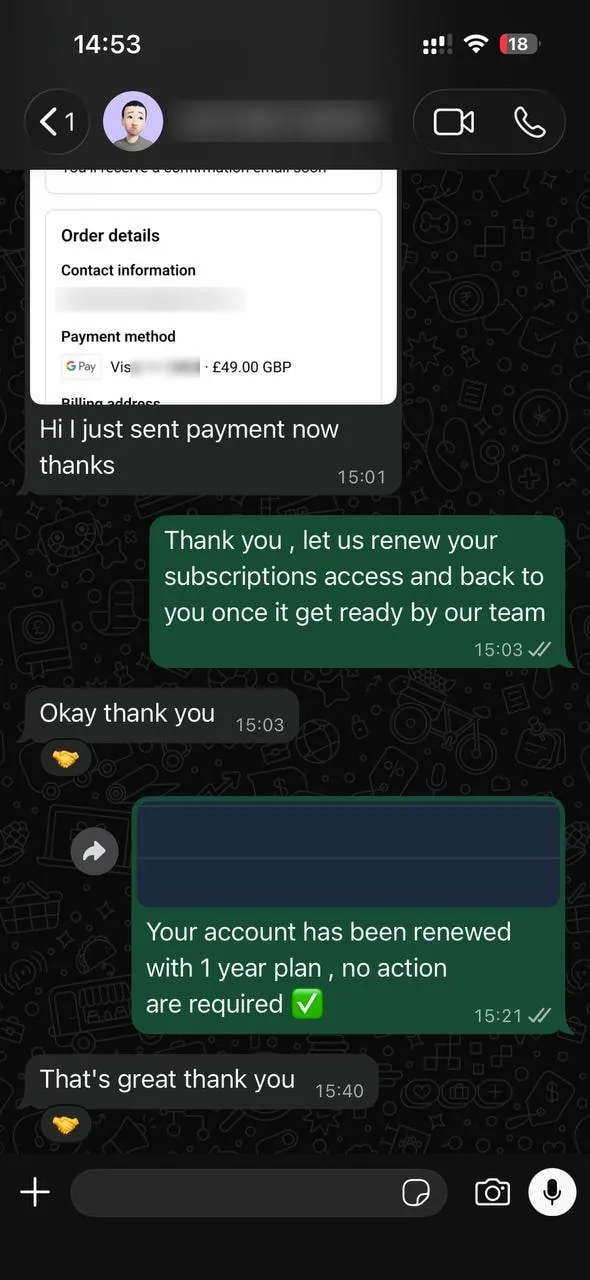
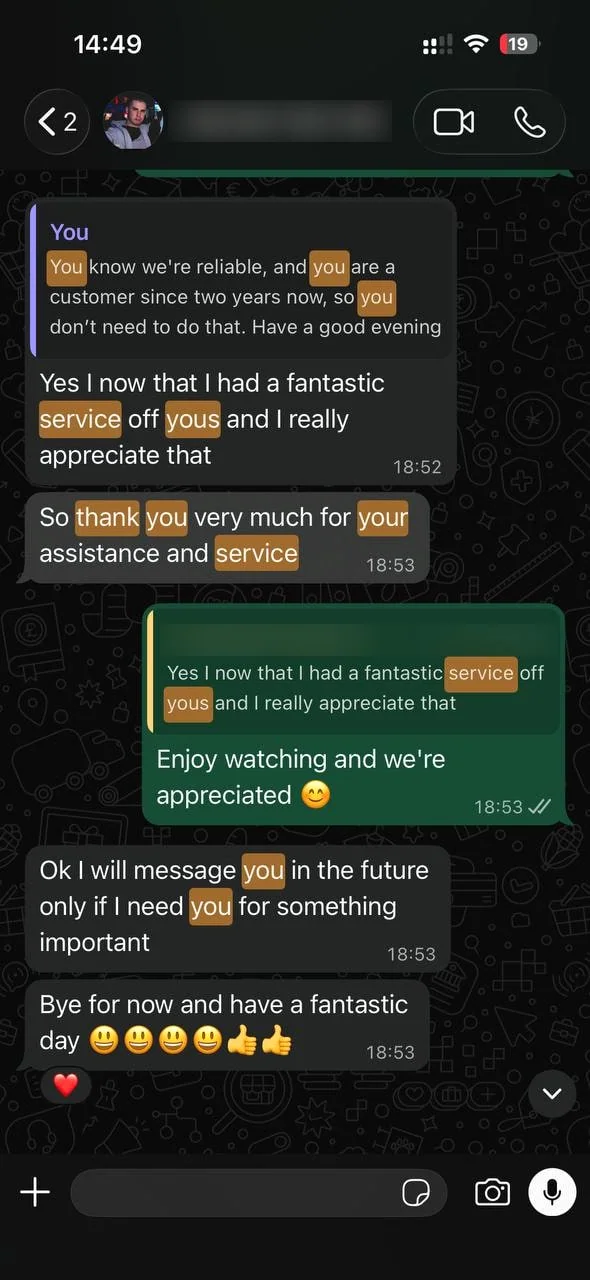
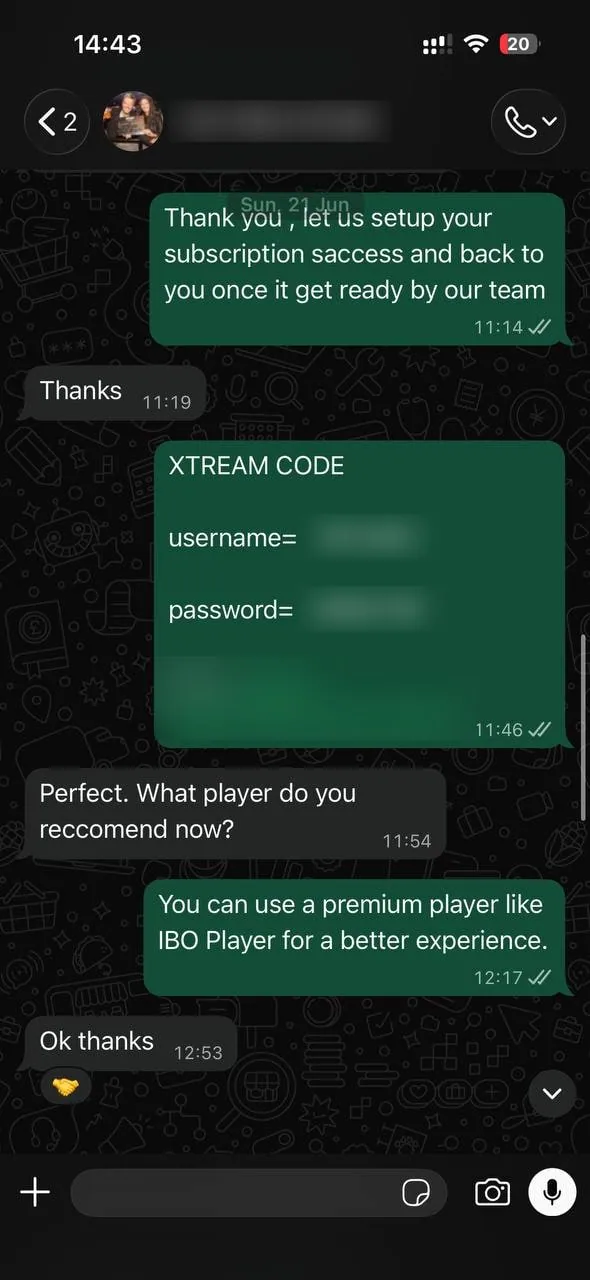
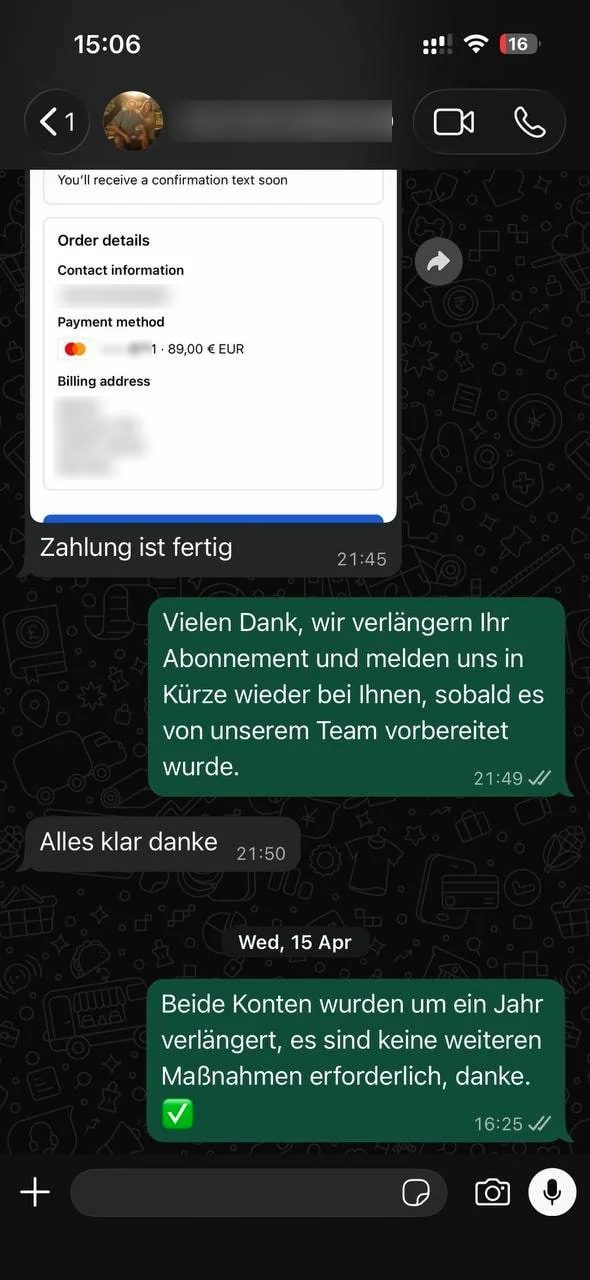
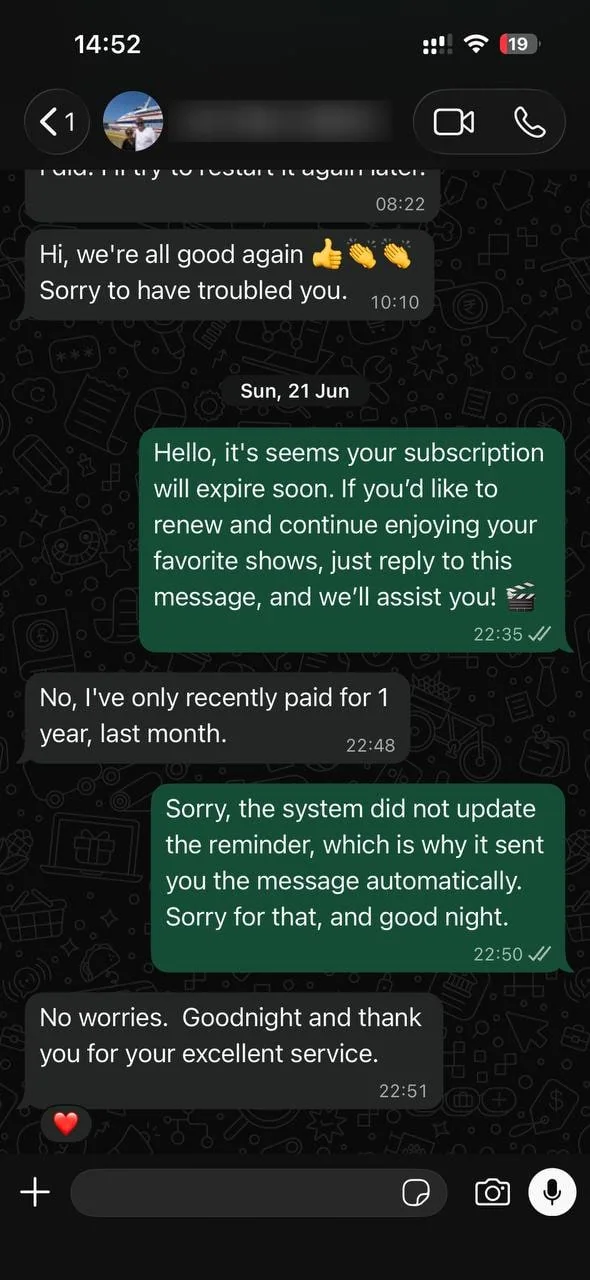
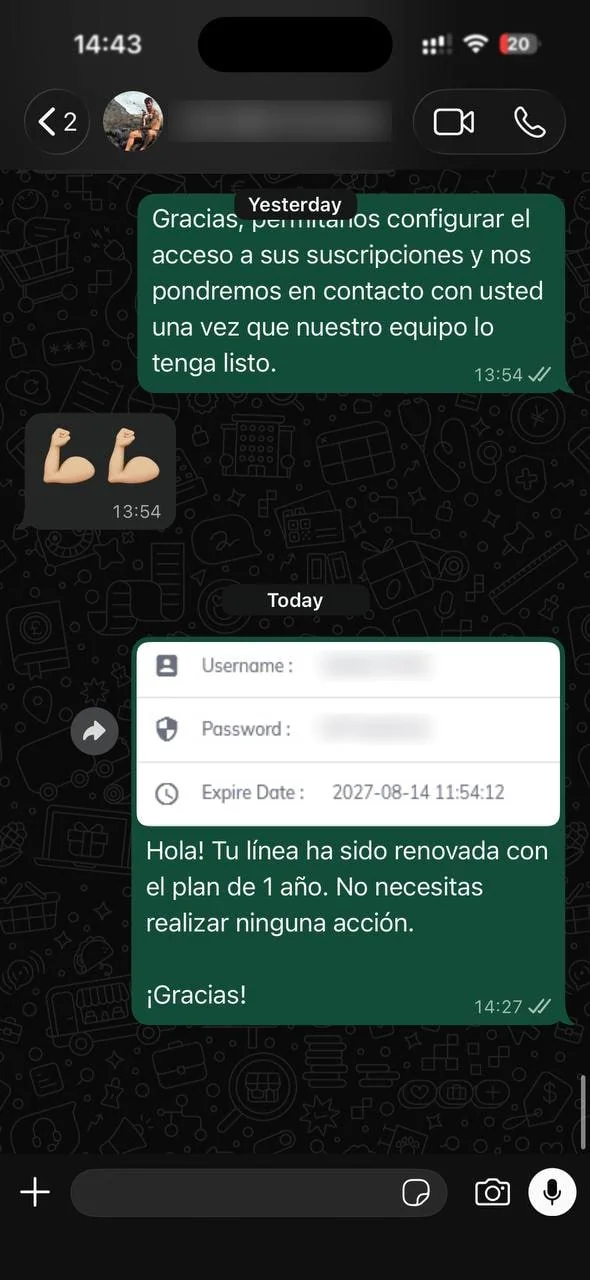
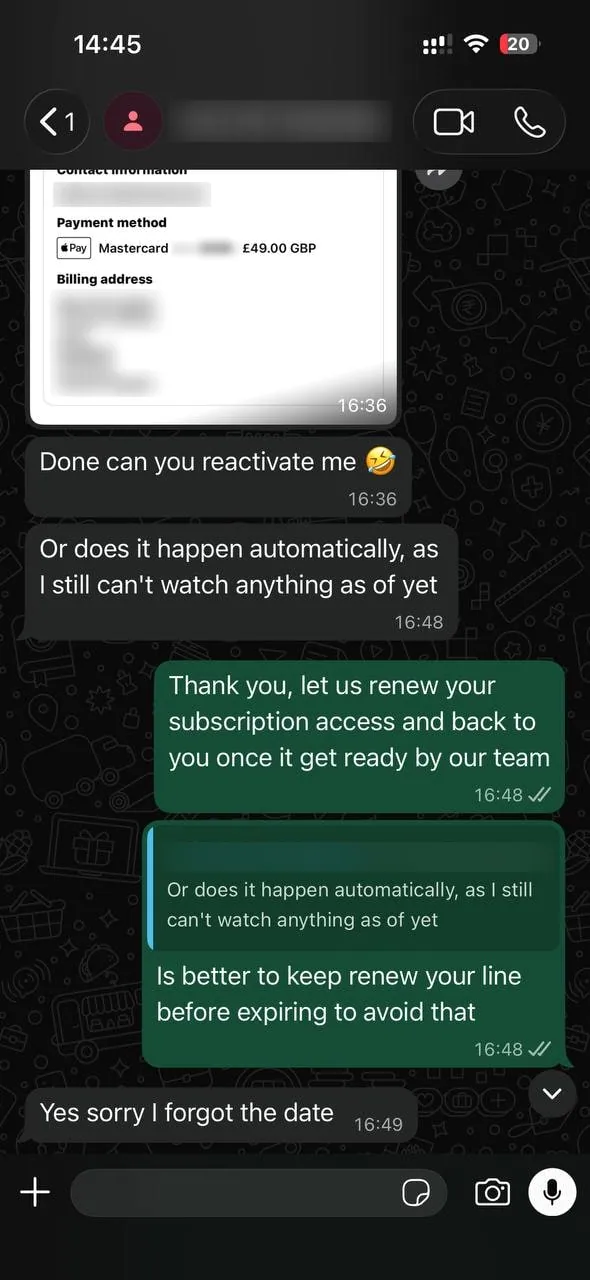
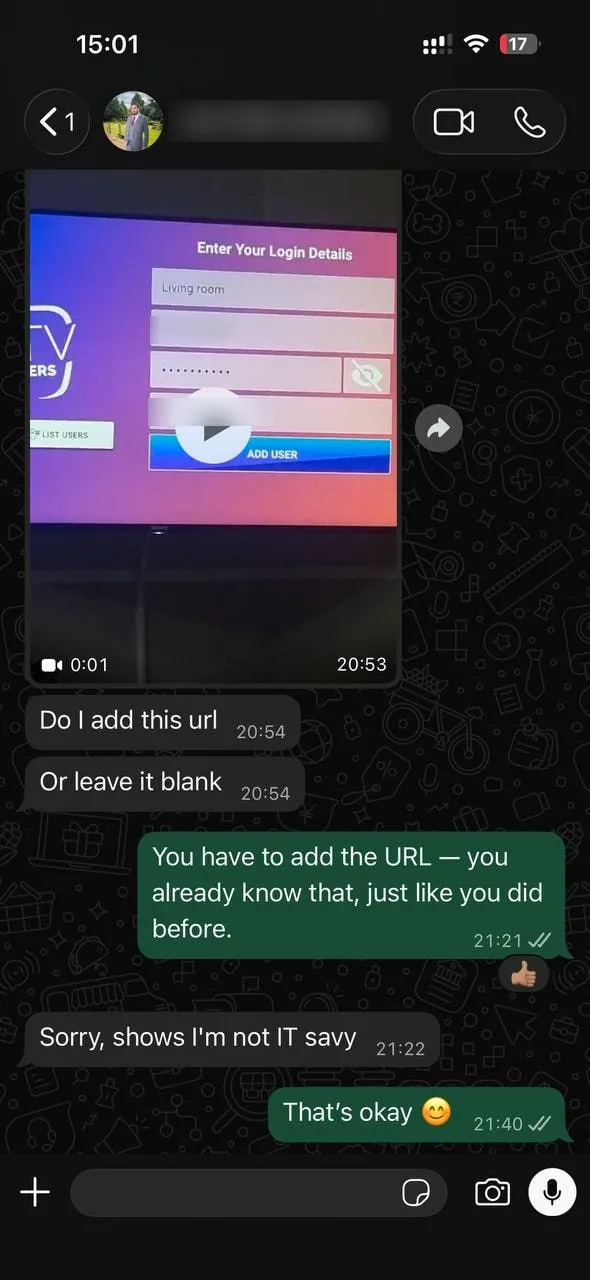
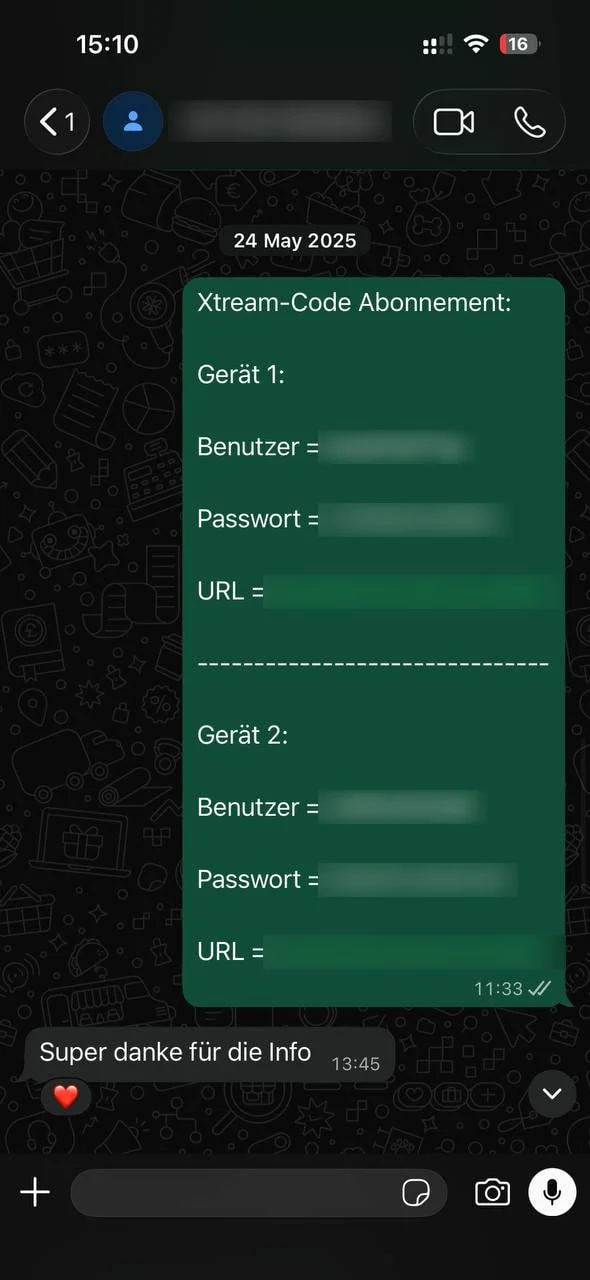
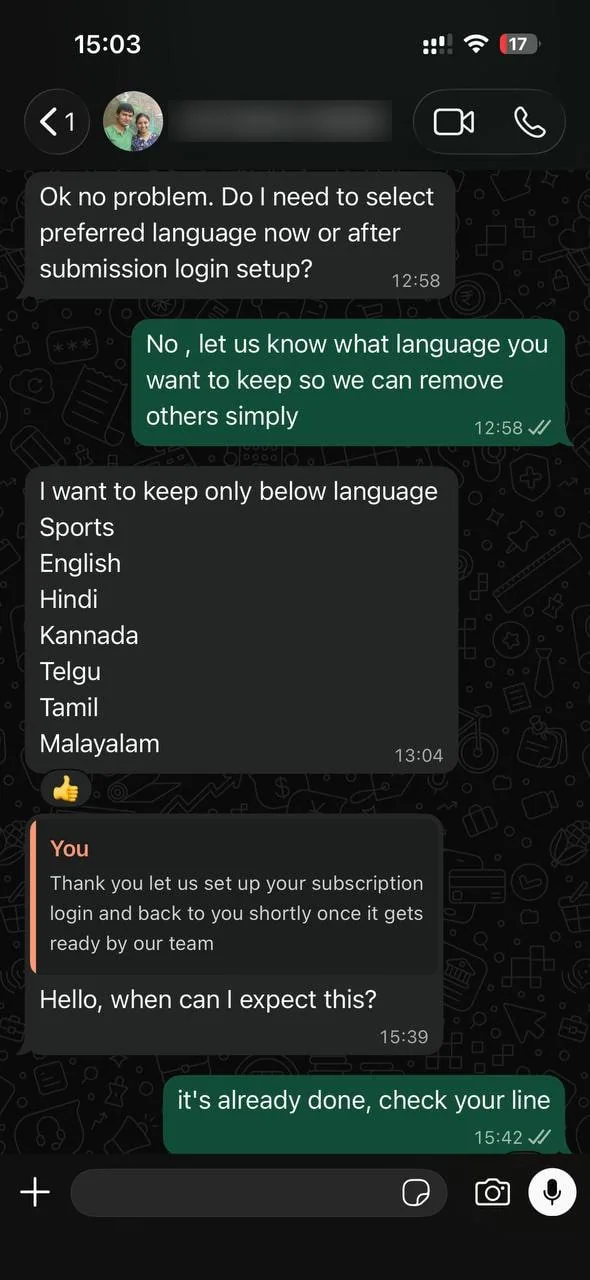
Tap a thread to read it here. Phone numbers, logins and card digits are destroyed in the image, not merely covered.
Interrogate us before you spend a penny
Nothing about this is meant to be a leap of faith. Open a chat and put the awkward questions first: what exactly the plan carries, which rails we settle on, how long the wait is once the money clears, and what recourse you have on the day something breaks. Whichever of these two apps is already installed will do.
WhatsApp +1 (501) 701-2848
Straight through to somebody who can answer. Nothing to sign up for, no reference number, no queue.
Desk is open · typical reply under five minutes Open a WhatsApp chat →Telegram @tvelitesupport
Identical desk, identical answers, for anyone who lives in Telegram rather than WhatsApp.
Open a Telegram chat →Here is exactly how the money moves
Choose a tier, hand it over on a rail that leaves you a record, and read your login in the chat a few minutes afterwards. Cards, PayPal, Apple Pay, Google Pay, crypto — and the second it clears, nothing belonging to you is retained.
- The figure is on the page before anything is asked of you
- One charge a year, never lifted automatically
- Cards, PayPal, Apple Pay, Google Pay or crypto
- Credentials land minutes behind the cleared funds
- 28,000+ live channels, 300,000+ on demand
- Live sport and title fights carry no surcharge
- Up to 4K on Firestick, Smart TV, Apple TV and phones
- A named human to chase the day something stops
≈ $5.75/mo · charged once · it simply lapses unless you decide otherwise
Keep reading
How the order works
The six steps from first message to first channel, the timings at each stage, and what a receipt has to contain.
Read the order guide →Which method to pay with
Card, Apple Pay, Google Pay, PayPal and cryptocurrency on speed, cost and the recourse each one leaves you.
Compare the methods →Our price list, in public
Three plans, three numbers, renewal quoted at the same one, and nothing kept on file after the payment clears.
See pricing →Where you stand on refunds
What qualifies, what does not, and how to ask — written down before you pay rather than decided afterwards.
Read the terms →The full FAQ
Renewals, devices, speeds, activation times — plus everything else that gets asked before an order goes in.
Read the FAQ →Who you are messaging
Why this site publishes its prices when most of the market will not, and who is on the other end of the chat.
About us →